
With the uncertainties of an ongoing war, El Niño, cyberattacks, increasingly severe weather, and who knows what else, it seemed timely to have a plan for a managing a prolonged power failure. So I’ve been looking at the options available to someone like me, living in a 2,800-square-foot suburban home in San Diego County.
My objective seemed fairly modest, yet the possible solutions turned out to be more complicated than I anticipated: keep the refrigerator and freezer powered, maintain an internet connection with my router, keep my phones and computers charged, and occasionally run an appliance such as a microwave, TV, or toaster. Lighting could all be handled using battery operated lanterns. I wasn’t trying to power the entire house, and certainly not the air conditioning.
The first step is to calculate how much energy these devices consume and then figure out an energy source to provide it for a few days. I estimated that these items would consume about 700 watts, with occasional higher demands such as when the refrigerator’s compressor starts up. I raised this to 800 watts because most power losses are not 100% efficient. Thus I needed a something to provide 800 watts – ideally for several days. That turns out to be a challenge, even with very large batteries.
There are essentially four different options: a large battery (like a Tesla Powerwall hooked up to home solar, a standalone battery, a permanently installed natural gas generator, and a portable generator using gas or propane.
Standalone backup batteries are essentially supersized versions of the batteries we use to recharge our phones using a different battery technology. Anker, Jackery, EcoFlow and others offer them in a wide range of sizes ranging from shoebox size to as large as a carry-on roller suitcase weighing 100 pounds or more. The contain an inverter that converts the DC power to AC. For powering modern appliances and computers you need the inverter to have low distortion (THD)- below 3%.
The batteries contain 120 VAC and often 240VAC outlets. Charge the battery from an electrical outlet, then plug your appliances directly into outlets using extension cords to various devices. A display lets you monitor usage and time remaining, and lets you check how a particular device impacts consumption. Most have an accompaning app that provides more information.
Ideally you select a battery that will get you through the outage. But even the largest models last less than a day, as I calculated below. The battery may get you through a short power outage, but for long outages you need a way to recharge your battery.
The Anker SOLIX F3800 is a good example of one of the larger home backup batteiries. It stores 3,840 watt-hours and costs about $2,700. Snapping on a second battery doubles the capacity to 7,680 watt-hours and praises the price to around $4,000. That seemed like a good option to investigate.
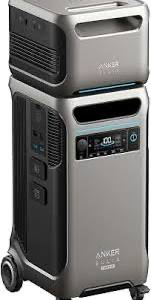
Using my 800-watt average needed during a power outage, the battery’s 7,680 watt-hours would provide about 9.6 hours of power (7680/800). If I only used 400 watts through the day, it would get 19 hours. But that isn’t enough for the kind of multi-day backup I’m looking for.
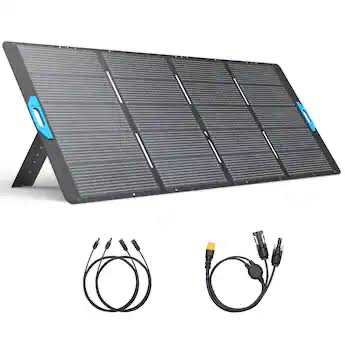
Anker recommends using their folding portable solar panels to recharge the battery. In my case, the calculations said I need 5 or 6 of Anker’s 400W folding solar panels, adding another $3000. We are now up to $8,000 to $10,000 for a battery and the means to charge it.
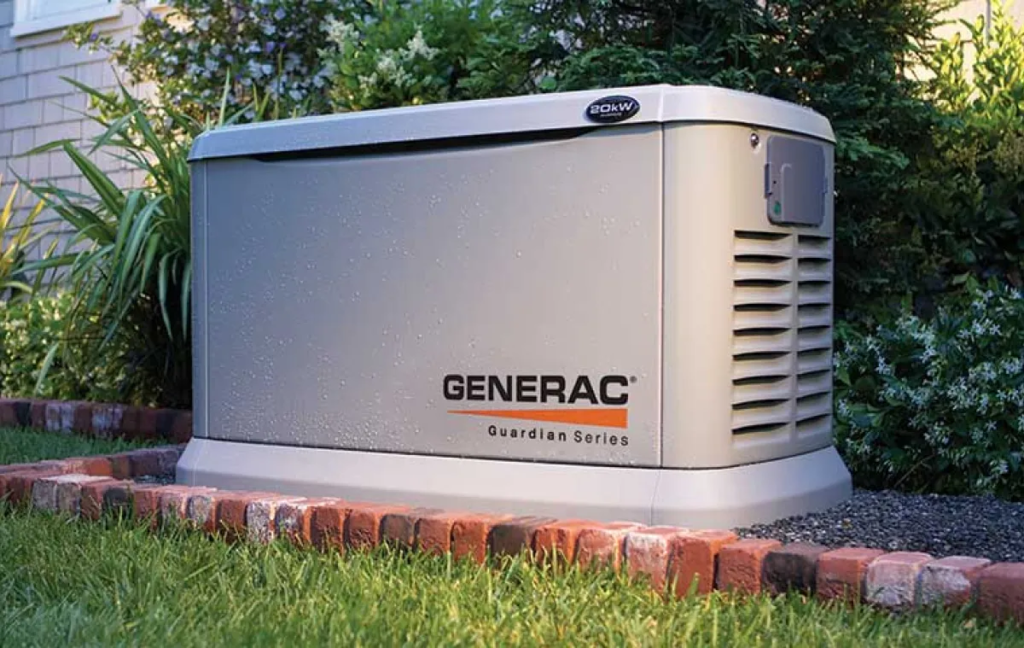
That amount is approaching the cost of a permanently installed outside standby generator, such as a Generac that connects to a natural gas line. The Generac home generator continuously monitors your utility power and automatically turns on when you lose electricity. An automatic transfer switch disconnects the house from your utility and connects it to the generator. The cost of a generator, installation of the transfer switch ranges from $13,000 to $20,000 depending on your home. Half the cost is the generator and the rest is the installation.
The home generator’s appeal is its convenience. When the power fails, the generator starts automatically. Depending on the size of the system and how the electrical panel is configured, it can power selected circuits or all of the house. The disadvantage, of course, is the price. You’re spending thousands of dollars for a system that may sit unused for months or years.
The third option is a portable generator. Today’s models are more advanced than the generators of the past, although they still are noisy, much like a power lawn mower. They contain an internal-combustion engine to drive an alternator and can run on gasoline, propane or, with some models, natural gas. Some even run on all three. Most newer generators use inverter designs that vary engine speed according to electrical demand and produce relatively clean electricity suitable for sensitive electronics.
The biggest advantage is cost and the fact that you aren’t storing electricity; you’re storing fuel. A battery eventually runs out. A generator keeps producing electricity as long as you keep supplying fuel.
As an example, the $1200 GENERAC IQ3800 works using a choice of gasoline or propane, and its AC output has low harmonic distortion, meaning its AV waveform will charge the battery without any issues. The Generac provides up to 13‑hour runtime on gas or 16‑hour runtime on a 20 lb LP tank at 50% load.
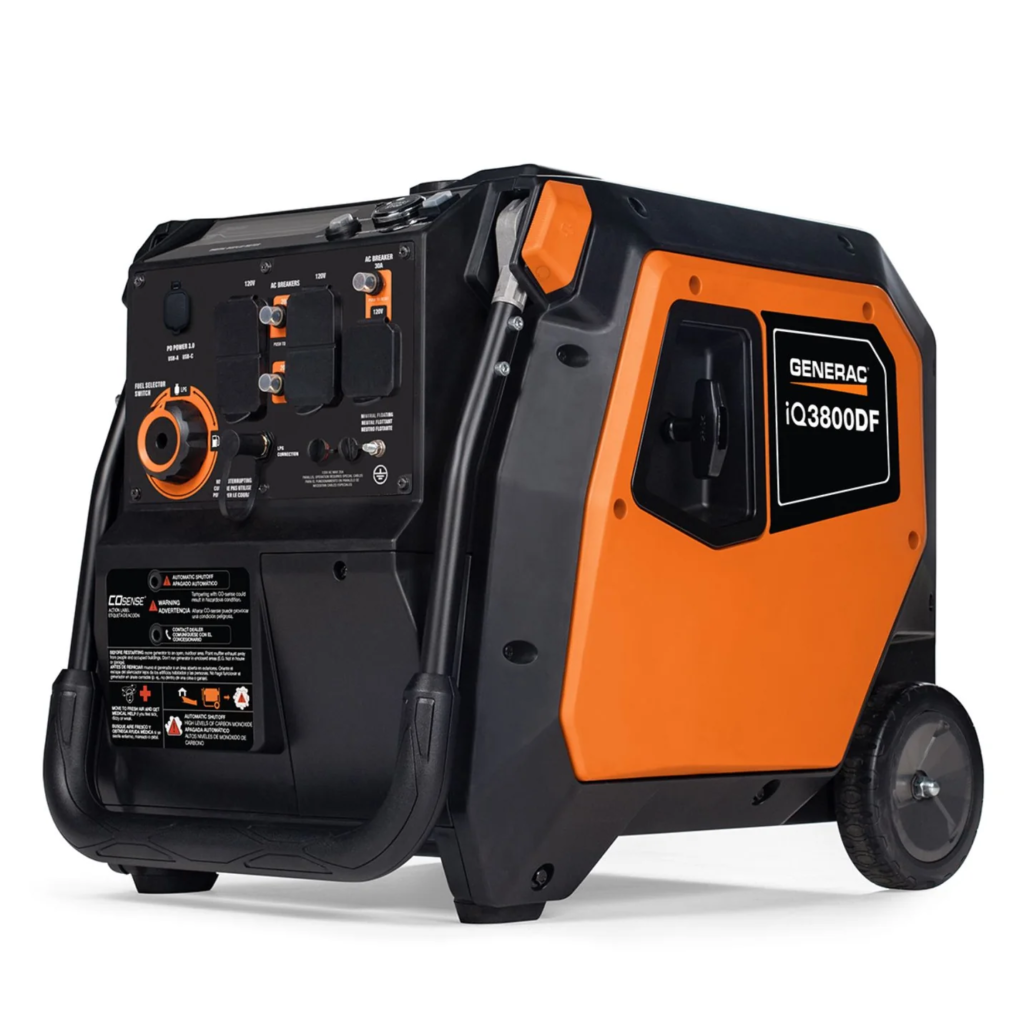
For a multiday outage, you need an adequate supply of fuel or a way to obtain more. You can plug appliances into the generator with heavy-duty extension cords or install a transfer switch. But there are two significant drawbacks.
First, a portable generator must be operated outdoors, well away from the house, as it produces carbon monoxide. Second, it’s noisy. Depending on the model and load, it can be a fairly noticeable presence in your backyard. Lastly, it’s not practical to store gas for very long because it deteriorates quicky; propane would be a better choice.
After looking at all three approaches, here’s my conclusion:
Batteries are wonderfully convenient, quiet and clean, but a battery by itself isn’t a particularly good solution for a multiday outage, in spite of all the ads from Anker, Jackery and others. It’s better for outages that last a few hours. Battery costs are high, you need a way to keep it recharged, typically lots of solar panels you need to unfold and set up. or, alternatively a portable generator, both of which require much more effort than the battery itself.
A permanently installed generator is cleary the most convenient solution. It starts automatically, can run for days and doesn’t require you to manage a collection of batteries. But it is also the most expensive option, and something rarely used.
For my particular needs, the portable dual-fuel or tri-fuel generator looks like the most practical and least costly solution, if I decided to proceed. It isn’t as elegant as a battery or as effortless as a whole-house generator. It’s noisy, has to be operated outside and requires maintenance and maintaining a fuel supply. But with several propane tanks, an expensive wiring job and switch to connect it to you electric panel, it will keep the refrigerator, freezer, Wi-Fi, lights and other essentials operating for days rather than hours.
Right now I’m hesitant to do anything and am re-examining my need for days of backup.
Comparison table
| Battery Backup | Standby Generator | Portable Generator | |
|---|---|---|---|
| Typical cost | $3,000–$10,000+ with additional batteries/solar | ~$13,000–$20,000+ installed | ~$1,000–$3,000+ |
| How it produces power | Stored electricity | Natural gas/propane | Gasoline/propane/natural gas |
| Typical duration | Hours unless recharged | Days, while fuel supply lasts | Days, while fuel supply lasts |
| How it’s replenished | Wall outlet, generator, or solar | Continuous fuel supply | Add fuel |
| Solar required? | Yes or a generator | No | No |
| Automatic startup | No | Yes | No |
| Noise | Silent | Moderate | Moderate to loud |
| Can power house circuits? | Yes, with transfer switch | Yes | Yes, with transfer switch |
| Maintenance | Low | Regular professional maintenance | Engine/fuel/oil maintenance |
| Major limitation | Limited stored capacity | High initial cost | Fuel, noise, manual operation, maintenance |
| Best suited for | < one day outages | Maximum convenience and long outages | Lower-cost, extended backup |

Generator sizing: You need to size a generator based on the inrush current, and not the normal load. To use the example, a motor will require a healthy amount of power to start. Once at speed, the amount of current needed reduces dramatically. Also HVAC compressors have the option of Hard or soft starting. A Hard start means it’s powering up quickly, meaning it draws a healthy chunk of energy to start, where a soft start will slowly start and not overly tax your gen.
Gasoline: It has a shelf life of about 3 to 6 months. i see lawnmowers, snowblowers, and generators at the curb for trash pickup fairly often…Killed mostly by bad gas gunking up carb’s.
Most generator engines were also designed in the 1970’s, before the use of Alcohol in Gas.
In generators at the end of use, drain the gas into your car. Replace the gas with special alcohol free stable gas. (4 cycle Tru-Fuel, VP SEF, etc.) Run for 5 mins, and store for up to 2 years.
Propane and Natural Gas do not have the storage limits, and run exponentially cleaner than Gasoline.
All backup solutions require upkeep. Batteries less so. Most Standby gens run weekly tests.
A poor man’s transfer switch is called an Interlock kit. It is a metal sliding plate that forces your utility main in your load center to be in the off position while a smaller (e.g. 30a breaker) is active.
Far cheaper and simpler install than a formal transfer switch.
If running a portable generator, always run outdoors.
Another issue – if you aren’t home every evening, the system needs to be automatic. Otherwise, everything in your refrigerator is at risk.
Thanks for publishing this. Another good installment in your “taking one for the team” series. I haven’t owned a home since battery backup became practical to consider (sold last one 15 years ago) but I remember running numbers and coming to similar conclusions on generator options back in the day. Mildly surprised at how little things have meaningfully changed in the past few decades.