
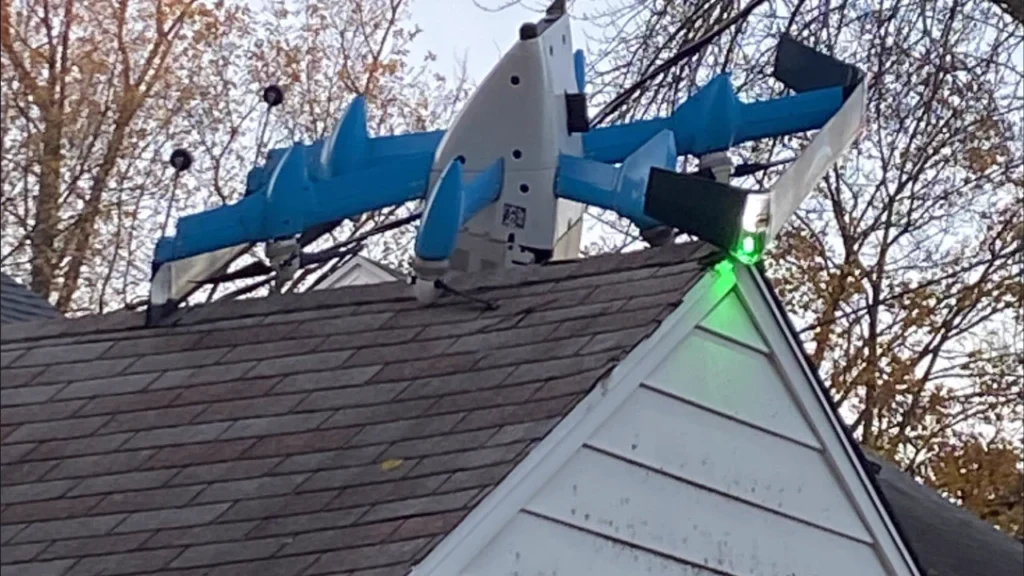
An Amazon delivery drone crashed onto the roof of a garage in Huntington Woods, Michigan, last Friday after delivering a bottle of shampoo. The drone had just delivered its package in a customer’s backyard when, during its ascent, it struck a cable, lost a propeller, and crashed onto a neighbor’s garage.
The aircraft weighed about 83 pounds. While nobody was injured, there was some damage to the roof, and neighbors reportedly experienced a temporary loss of internet service. Amazon subsequently issued a statement that safety is its top priority and that such incidents are extremely rare.
But the question nobody seems to be asking is: Why we need an 83-pound aircraft flying over residential neighborhoods to deliver a bottle of shampoo in the first place?
To me, the incident is a perfect metaphor for what’s going wrong with much of the technology industry. Companies are introducing increasingly sophisticated technologies to solve problems that barely exist, that only benefits themselves, while expecting the rest of us to live with the consequences.
Amazon wants to automate deliveries to reduce their labor costs and deliver products faster. But what’s in it for us? Do we really need a bottle of shampoo delivered in 30 minutes rather than a few hours or even a day later? And what about the neighbors who didn’t order anything? Who gave Amazon permission to expose hundreds to the noise of the drone’s propellers, have aircraft flying over their homes, and taking on the risks of these pilotless flying machines. They receive none of the benefits, yet their quality of life is diminished.
Imagine sitting in your backyard reading a book, enjoying or simply appreciating a quiet afternoon, while a steady procession of commercial drones flies overhead delivering deodorant, batteries and dog treats.
Amazon says it is already making nearly 6,000 drone deliveries a day and has announced plans for an enormous expansion. Imagine what our neighborhoods might sound and look like if Amazon, Walmart and every other major retailer eventually operate competing fleets of delivery drones. When were we asked whether we wanted this?
This same mentality is evident throughout the technology industry, particularly with artificial intelligence. Companies are replacing customer service representatives with AI chatbots, often making it harder to resolve a problem. They’re inserting AI into software that worked perfectly well without it, adding complexity and sometimes making the products less intuitive. They’re generating enormous quantities of questionable content that pollute the internet, making it increasingly difficult to distinguish what’s authentic from what’s fabricated.
Meanwhile, communities are being asked to accommodate huge AI data centers, with their needs for electricity, water and land. The financial benefits go to the technology companies, while much of the costs are borne by the general population.
There should be a much higher threshold for introducing commercial technologies that intrude into our public spaces, compromise our privacy, consume our resources or diminish our quality of life. Companies should be required to demonstrate meaningful public benefits, not simply that their products can be made to work or that deploying them will improve their financial results.
Technology should make our lives better, not merely make technology companies more profitable. A quiet neighborhood, an uncluttered sky, a sense of privacy and the ability to enjoy our homes without commercial intrusion are things worth preserving.
And if preserving them means waiting until tomorrow for a bottle of shampoo, I think most of us can manage.
