
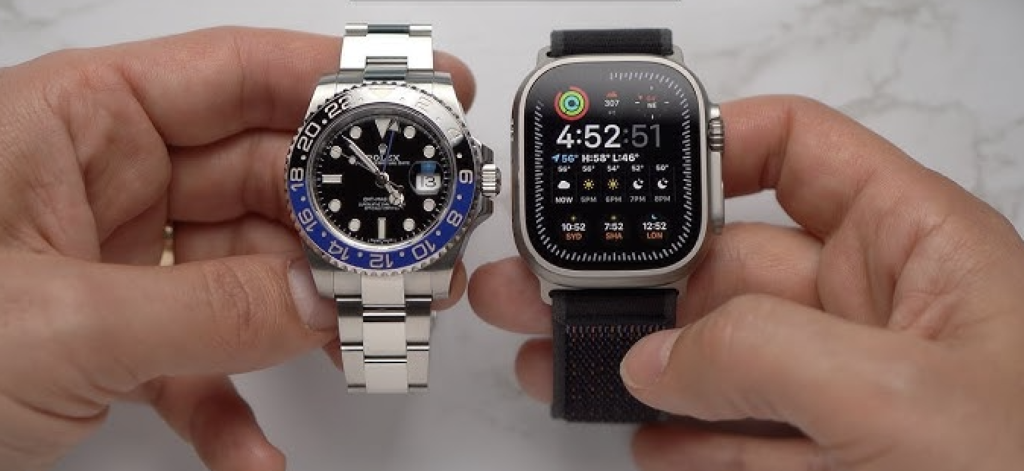
Each of the many times I flew to an international destination for business—more than 100 times —I went through the exact same ritual. As soon as I stepped onto the plane, I would manually change the time on my mechanical watch, mentally placing myself in the time zone of my destination. Like so many things, I assumed that small ritual has largely vanished in the digital age, replaced by the effortless auto-syncing of the Apple Watch and similar digital timepieces from Garmin and Samsung.
Yet, on a recent trip, I noticed something unexpected: a proliferation of old-school analog timepieces on the wrists around me. Many of them were high-end mechanical timepieces from Rolex and other luxury makers. It got me thinking about just how much the landscape has shifted, prompting me to look into the data. What I found surprised me.
I remember when the Apple Watch debuted in 2015. The Swiss watch establishment scoffed. Jean-Claude Biver, then-head of TAG Heuer, famously dismissed it as looking like a first-trimester student design project with “no sex appeal.” Even I, reviewing it for my newspaper column at the time, was highly skeptical, questioning how a piece of disposable tech could ever compete with a fine mechanical watch.
More than a decade later, the verdict is in. Apple indisputably won the war for volume, but the Swiss watch industry didn’t lose.
By 2017, Apple was already outshipping the entire Swiss watch sector combined. By 2023, that gap became a chasm: Apple shipped roughly 37 million units—more than double the 16.9 million watches exported by all the Swiss watch brands combined. In the entry and mid-tier segments ($200 to $800), Apple trounced the competition, capturing the mass market.
But volume doesn’t tell the whole story. While the Apple Watch generates an amazing $17 billion to $20 billion annually, its explosive early growth has plateaued; sales are now largely driven by replacement cycles of current users. Meanwhile, the Swiss industry generates over $27 billion in annual sales. They achieved this by consolidating and moving into the very high end. In one way it defines logic if you think of a watch as an instrument. The mechanical watches are less accurate, display less information, and require more care
Many of the historic private watch companies were snapped up by luxury conglomerates. Today, just three giants—Richemont, LVMH, and the Swatch Group—control the vast majority of the prestige market. The most coveted independent brands, including Rolex, Patek Philippe, and Audemars Piguet, have resisted acquisition. That independence is a part of what sustains their mystique and value. Their ads talk about their history, tradition, and the art of fine watchmaking. Patek ads talk about passing your watch on to your offspring.
Instead of fighting Apple on utility—where no mechanical watch can compete with its digital accuracy—the Swiss stopped marketing watches as tools to tell time and began selling them as symbols of permanence, heritage, and prestige. Each watch company has their own story, some are connected to the pilots of last century’s wars, some are related to mid-century artisians.
Brands, most notably Rolex, adjusted their models toward using higher-end materials, more complex mechanical movements, and substantial price increases. While the average Apple Watch sells for about $500, the average Rolex is about $14,000.
They also created demand through scarcity. By keeping production limited (Rolex produces roughly 1 million watches a year compared to Apple’s 37 million), they created long waiting lists. Today, a new Rolex often requires a year or two of waiting. Walk out of a boutique with a new Rolex or Patek, and its market value is immediately higher than what you paid. That’s not so with many of the brands owned by luxury goods companies.
Ironically, these companies focusing on heritage and their watchmakers’ intricate hand-assembly are now using cutting-edge technology to build their watches. While final assembly and adjustments still require a master watchmaker’s human touch, modern Swiss factories are filled with multi-million dollar automated machinery, carving gears and cases out of solid precious metals with microscopic precision. From the best information I could get, margins of these watches approach 80-90%, meaning a $10,000 watch costs $1000 to $2000. Much of the margin goes into the advertising, the elegant boutiques, and the expensive catalogs and magazines.
Without a doubt, the winner of this strategy is Rolex. Shipping 1/40th of Apple’s volume, its premium pricing has allowed it to reach annual sales of $10 billion, closing in on the Apple Watch’s revenue.
What we are left with today is not one watch market, but two entirely separate ecosystems that happen to occupy the same place on our wrist. Apple dominates wearable technology, selling health tracking and convenience. Rolex and Patek Philippe sell mystique, history, craftsmanship, and investment value. By completely bifurcating the market, both sides found a way to win.
As a mechanical engineer I have bought and sold mechanical watches over the years and even toured several Swiss watch factories. While I still wear a mechanical watch occasionally, I tend to gravitate to my Apple watch when traveling overseas. It doesn’t attract attention and it’s many complications make it more practical and useful.
