
Tim Cook just stepped down as CEO of Apple and two of his last actions tarnished Apple Maps, just as Apple Maps tarnished Tim Cook’s reputation when he launched the deeply flawed app shortly after he became CEO.
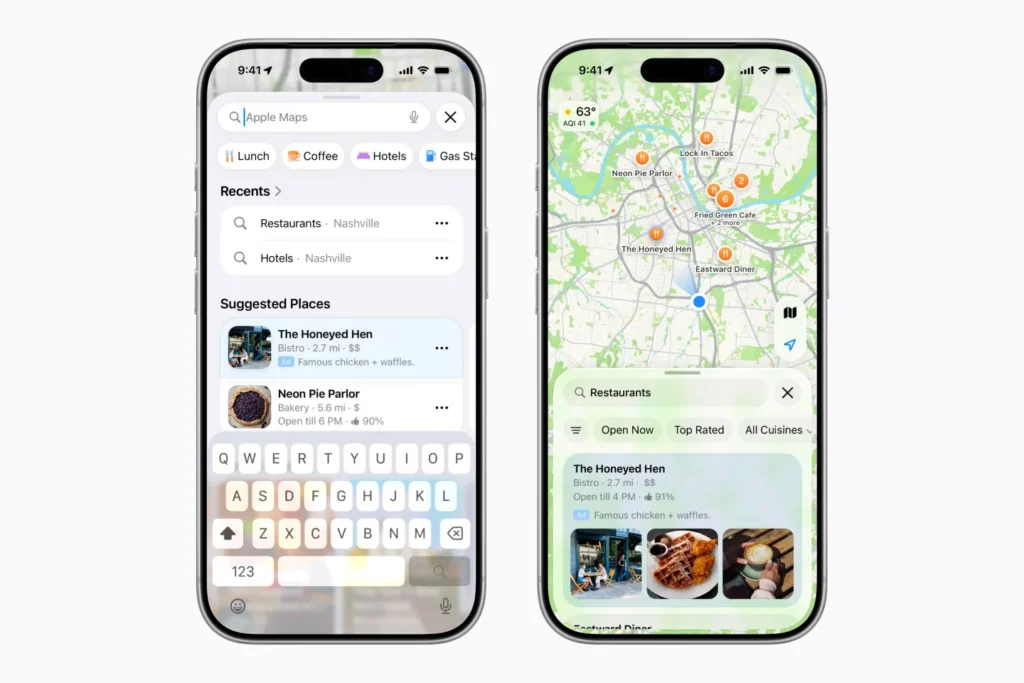
His first action was putting ads on Apple Maps, one of the few places on the internet where we weren’t constantly fed distracting advertising. Apple will now begin placing them in the app for U.S. and Canadian customers into our search results for restaurants, stores and other destinations. As an example, I just searched for yogurt in my neigborhood and up came an ad for Aldi’s Supermarket at the top of the list.
Apple’s approach is a bit different from Google, at least for now. Google Maps has had advertising for years. It puts sponsored businesses at the top of search results, promotes locations on the map itself, and shows sponsered businesses while you’re getting directions. As is done with most of its apps, Google has built Maps into its advertising platform, where businesses compete for visibility using Google’s advertising engine.
For now Apple is not going that far. But like most things with ads, it will inevitably get worse over time. Apple says that only one sponsored result can appear at the top of a search result and ads can also appear under suggested places before a user searches. They are marked with a small blue “Ad” designation, but otherwise are designed to look much like ordinary business listings.
Apple’s move is very disappointing because it goes against their promise to keep their products free of distractions, simple to use, and to put the customer experience first. When I use a map, particularly in the car, I’m trying to do something specific, such as finding a restaurant, locating a gas station, or traveling to a destination, and I don’t want to be distracted with something that doesn’t interest me or isn’t relevant.
Apple for now has restrictions on what can be advertised. Some home-service businesses, including plumbers, electricians, locksmiths, HVAC companies, and contractors, are excluded. Medical advertising is subject to review. Apple says that information about the ads that users see or interact with in Maps isn’t associated with their Apple Account, and that personal information isn’t collected, stored or shared with third parties for this advertising.
That’s in contrast to Google’s much broader advertising ecosystem, which has been built around their ability to know much more about us through tracking our location, reading our email, following our website visits, etc. That makes it even more surprising that Apple wants to serve us ads that will be less relevant.
It’s a safe bet that this is just the beginning of Apple’s efforts to serve us more advertising. Once Apple discovers that businesses will pay for a position at the top of a Maps search, why stop at one business? Why not two? Three? Why not promote locations on the map? Why not advertisements along a driving route? Why not deals and offers based on where you’re going?
That’s precisely how these products evolve. It’s called enshitification*. And nearly all the tech companies do it.
* Enshittification, also known as crapification and platform decay, is a pattern in which two-sided online products and services decline in quality over time. Initially, vendors create high-quality offerings to attract users, then they degrade those offerings to better serve business customers (such as advertisers), and finally degrade their services to users and business customers to maximize short-term profits for shareholders-Wikipedia
A feature begins as something modest and useful. The company discovers that consumers tolerate an ad or two on occasion, and more ads creep in until the app is more cluttered, much less useful, and no different from its competition. Eventually, the product becomes a profit center and those that manage it are incentivized to increase profits, with user experience and performance no longer the top priority.
But Apple has something to lose here that Google doesn’t. Maps are part of Apple’s carefully controlled hardware-and-software experience. The company has always emphasized that its products should feel polished, simple and relatively free of commercial clutter. While this may seem like a small step, it’s an early indicator of deterioration of the Apple ecosystem.
And Even Worse…
Which brings us to Cook’s other last act, joining Google Maps in renaming Lake Ontario “Lake America” for users in the United States. Google made the change first, and Apple quickly followed suit, after President Trump ordered federal agencies to use the new name because he became irritated at Canada for not agreeing to a new tariff agreement.
Apple and Google both chose to do so to please Trump. Trump even bragged about Apple doing it at his request.
There is also something strange about seeing different names for the same lake on both apps, depending on where you live. An American looking at the app sees Lake America. A Canadian looking at the same lake sees Lake Ontario.
We once assumed maps are about providing us with a useful reference that communicates accurate geographic information. They tell us where things are and what they’re called. That makes them different from social media, where political arguments and opinions vary. A map is not someone’s opinion.
We’ve always assumed that geographic names only change for good reason such as border changes, countries renaming themselves or uniting. But this is different. Nothing about the lake has changed. It’s in the same location. The name changed simply because the president wanted it changed, and two of the world’s biggest technology companies decided to go along.
Apple and Google’s actions should raise a further question about the power they have over the information we see every day. Their maps are used by hundreds of millions of people. When they change something as basic as the name of a major geographic feature, users will treat it as factual.
You would think these two companies with enormous influence would take much more care and be more responsible about what they say and do. They’re in a unique position of responsibility, and when they discard their principles on a whim, they do great damage to our country and to their own reputations. Maybe it’s time to start using a RandMcNally Atlas once again.
For now the best alternative is MapQuest that specifically rejected the name changes Trump demanded. It suddenly became the number one downloaded app from the App Store.
These two actions and others demonstrate the worst of big tech. No longer is it “do no evil.” It’s do whatever is needed to please a wannabe dictator, make even more money, while compromising the customer experience. No wonder so many are rising up and fighting data centers, Flock license plate cameras, and eyeglasses that film you secretly. Fewer and fewer of us trust or like big tech because big tech is showing they don’t like us.

Terrible news. I don’t expect Apple to offer its products for free, but I sure don’t want to have to be clicking off ads from my road map while I’m driving 65 mph along I-80. I’ve had an online ad for a yellow shirt following me around the Internet for months. I sure don’t want to see it on the road.
I’m pretty sure I’ve made my feelings (read: disdain) about Apple known here before, but kudos for calling both Apple and Google out on their self-inflicted Maps damage. I was an unconscious power-user of Google Maps for years before they forced me to be aware of how thoroughly evil they’ve become. I’m getting reacquainted with MapQuest and my patience with them will be maximal since the choices are so limited.
P.S. I was slow to read your excellent piece about luggage and so was unable to comment there, but still want to give you a shoutout for being geeky enough to both perform that research and share it with the world. I have a Briggs & Riley 22″ rollaboard purchased in 2009 (from which I’ve lived as long as two weeks on the road) and a computer bag of theirs purchased in 2010. I don’t expect to purchase any other luggage for myself for the remainder of my life.