
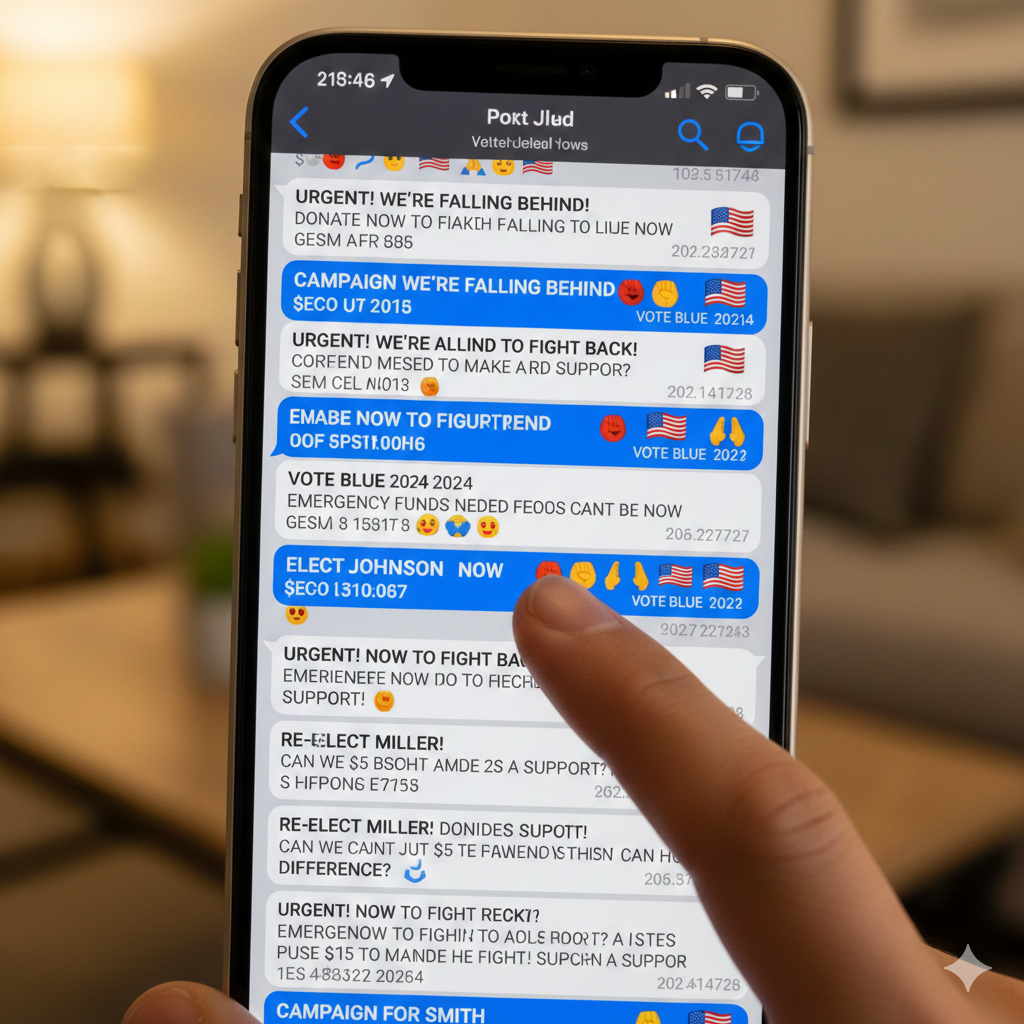
My phone messages are being filled with a continuous torrent of requests for donations from our politicians. Day and night, I, a stranger they’ve never met, receive texts telling me I hold the key to saving their campaign. The tone is always frantic. “We are begging you.” “We are collapsing.” “We will not survive the night.” They sound less like leaders and more like someone banging on a vending machine hoping a snack will fall out. Typically I get ten or more a day from an assortmant of candidates and reps from the party I support, but also a few from the other party, as well.
What they don’t seem to understand or care is how desperate these messages make them look and how insulting to us they are. If you want to project strength, maybe stop texting people with these inane messages. They want us to think of them as stong, bold, and worthy of our trust, yet the texts read like a cry for help from someone that’s about to drown. It is hard to trust people with the future of the country when they cannot even maintain basic dignity in a fundraising text.
Of course, most of them are not doing the actual texting; it’s usually the hired consults and PACs acting on their behalf. That also doesn’t speak well of them, since they are actually paying people to do it. On occasion when I once contributed, they would pester me again – often the same politician on the same day asking for more money, making me regret my first contribution and convincing me never to donate again.
And here’s something that’s never addressed: When someone sends a contribution, how much of it goes to the campaign? Or does most of a donation go to the consultants, firms, and whatever fundraising machines that pump out these messages? Some reports indicate about 10% goes to actual ground campaigns, while the rest goes to more fundraising, including more texts! Imagine contributing to the campaigns that will use our money to further harass us!
It’s really insulting. It seems like they think of us as fools. They recycle the same scripts, the same fake intimacy, the same “you are one of my top supporters” line that makes no sense when it is sent to millions of people. They send countdown clocks, pretend they are texting personally, and expect us to fall for it.
And, of course, making any contribution makes it worse. Once you end up in the political ecosystem, it spreads far and wide, because they sell your name. Soon you get messages from politicians you’ve never heard of, each with their own urgent message about a deadline, a poll, or an opponent who is apparently seconds away from ending democracy.
If politicians want respect, they need to stop sounding like con men. Speak to voters like adults. Ask for support without theatrics. Show confidence instead of panic. Because right now, the nonstop texts do not make them look strong or serious. They make them look just like hucksters, convinced we will fall for anything.

You hit the nail on the head (ditto for your post on surveys)!
Phil, it is indeed annoying. No good deed goes unpunished. This is true of political contributions and charitable donations. The minute you give, the onslaught starts asking for more. For political texts, I respond STOP and that particular politician no longer solicits. But there are always more. Using STOP does keep them to a manageable level.
I’m glad that works for you, but for me it’s hard for me to see any relief because there seems to be a limitless number of phone numbers being used.
Phil, it is indeed annoying. No good deed goes unpunished. This is true of political contributions and charitable donations. The minute you give, the onslaught starts asking for more. For political texts, I respond STOP and that particular politician no longer solicits. But there are always more. Using STOP does keep them to a manageable level.
There are politicians running in states other my own who I hope will win their races, but I will not contribute to them (except in a Presidential race). There are too many such appeals, so I limit my contributions to candidates in my own state. Years ago, I received a barrage of robocalls from a U.S. Senator running for reelection in my state . I got fed up, looked up his home phone number, and called it. His wife answered. I told her that her husband had opened the door, and I would call their house every time that I got a robocall from him. I told her to look at her caller I.D., and if she wanted preclude my calling again, she shoud have her husband’s campaign remove me from their call list. I never got another robocall from him.