
The electric vehicle market is currently undergoing a major recalibration. While this may be a crisis for the industry, it’s the best thing that could have happened for those in the market for an EV.
The landscape for EVs today looks nothing like it did two years ago. We’ve moved past the early adopter phase where EV choices were limited and prices were sky-high. The market has matured and we’re seeing a greater variety and many more lower cost vehicles this year: EVs costing as little as $30K and lease deals for as little as $300 per month.
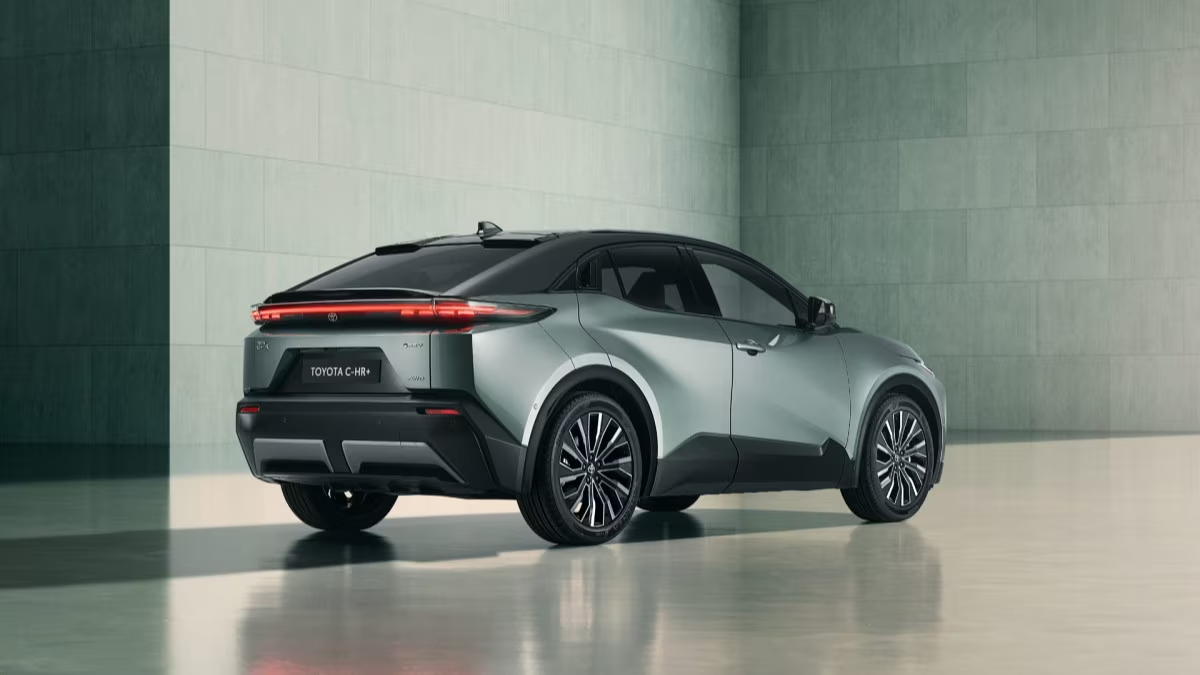
There are currently about fifty EV and plug-in hybrid (PHEV) models spanning every category, from the budget KIA Niro, Chevy Bolt, and Toyota C-HR – all around $35K – to the $70K and higher luxury SUVs and sedans from BMW, Audi, Cadillac, Mercedes, Genesis, and Rivian. Along with the lower-priced new EVs are two to three year old luxury EVs that have taken a big hit in depreciation.
When I leased my Lexus RZ in 2023, discounts on this model were roughly $15,000–$20,000 off the $60K sticker price due to its limited 230-mile range-which didn’t matter to me – but mattered to the reviewers. Other comparably-equipped luxury SUVs were in the $65K-$100K range, making the Lexus a great buy and an outlier. However, three years later, because EVs have depreciated much faster than ICE cars, its market value is substantially lower than the lease buyout price. I’ll be reluctantly returning the car at the end of the lease—adding yet another vehicle to the growing oversupply of used EVs.
The table below shows why used EVs are such a good bargain: they’ve depreciated substantially more than an internal combustion engine (ICE) vehicle. But it also suggests that buying a new luxury EV may not be wise unless you plan to hold it for five years or more.
| Vehicle Type | Average 3-Year Value Loss | Typical Resale Value (% of MSRP) |
| Standard Hybrid (HEV) | ~30% | 70% |
| Gas (ICE) | ~35% | 65% |
| Plug-in Hybrid (PHEV) | ~42% | 58% |
| Electric (EV) | ~52% | 48% |
The oversupply of used EVs is also a result of the massive surplus of used Teslas and the price erosion of their used cars. For years, Teslas once held their value better than almost any car on the road. Today, the market is flooded with them. While high sales volume is a factor, there is also a measurable erosion of the brand. A significant number of owners are trading in their Teslas due to a dislike of CEO Elon Musk’s polarizing public persona. Tesla has lost nearly 60% of its brand reputational value in 3 years, suffered its first sales decline in over a decade, and alienated its core customer base. Few CEOs have ever accomplished such a feat!
Here are a few examples of the second-hand market where low-mileage vehicles are selling for 50% less than their original MSRP:
- The Hyundai Ioniq 5, which won nearly every Car of the Year award at launch, has seen early-model resale values dip toward $22,000 compared to the original $50,000.
- A used Genesis GV60, a $60,0000 car I had looked at and liked a lot 3 years ago, is available now for $30,000.
- Used Tesla Model 3s are now frequently listed between $20,000 and $25,000.
After driving an EV for three years, I remain positive about the technology, but I do miss my Chevy Volt—the PHEV that GM discontinued in 2019. Since I rarely drive more than 50 miles a day, the Volt and the Lexus offer much the same gasoline-free experience.
It’s disappointing and surprising that no modern PHEV has emerged that surpasses the Volt’s 58-mile electric range. You would expect the market to have hit the 100-mile mark by now, but as the table below shows, the industry has yet to match the 2019 Volt.
The closest in price and performance is the Prius PHEV. My wife’s car is a Toyota RAV4 PHEV and it’s the best car we’ve ever owned. She consistently gets 50 miles of gas-free driving on a full charge.
| Category | Model | Electric Range (Est.) |
| Luxury SUV | Mercedes-Benz GLC 350e | 54 miles |
| Luxury SUV | BMW X5 xDrive50e | 38–40 miles |
| Compact SUV | Toyota RAV4 Prime | 42–50 miles |
| Sedan | Toyota Prius Prime | 44 miles |
| Midsize SUV | Mitsubishi Outlander PHEV | 38 miles |
| Family SUV | Kia Sportage PHEV | 34 miles |
The environmental case for both categories of these EV cars remains a big plus and the reason why I’ve been leasing or buying EVs/PHEVs since 2012.
This may be the first time I’ve even considered a used car because you can get so much for your money and avoid the huge depreciation that occurs over the first few years. The unfounded fear of batteries not lasting more than 100K has dissipated and EVs typically are more reliable and need less maintenance than an ICE car.
The other thing to note is many cars are built around the same EV platform. For example, Lexus, Toyota and Subaru share a common EV platform on five different models. Similarly with Hyundai, Kia, and Genesis. That means much of the price differences are for the extra amenities and body size, rather than the basic EV design itself.
In short, 2026 is the first year where you can buy some very good EVs, both new and used for $25K to $40K, almost half of what you would have paid just three years ago. While the industry may be struggling, it’s now a buyer’s market for the automobile design of the future.
