
The companies that once sold themselves as engines of freedom— empowering individuals, bringing people together, and helping the world—are becoming something else entirely. I understand only too well; I moved to Silicon Valley in 1996 to join the many that wanted to use technology to make the world a better place.
But it’s become clear that these companies are no longer standing up for democracy. They are no longer defending people. Increasingly, they resemble a consolidated power bloc led by wealthy and unaccountable billionaires, willing to align with authoritarians, so long as profits and control keep flowing.
This is how corruption starts and democracy ends—not by villains with mustaches, but with executives telling themselves they are being pragmatic and doing what’s best for their shareholders.
Tech leaders are now routinely cooperating with politicians hostile to democratic norms, labor protections, and civil liberties. They provide data, infrastructure, services, and platforms to governments that surveil, intimidate, and punish. They stay silent when elections are undermined, when judges are attacked, when protestors are tracked and even murdered. Silence is easier than resistance.
And behind the scenes, they are developing AI to give them even more power. Artificial intelligence is not being deployed primarily to help people live better lives. It is being deployed to replace workers, weaken labor, and concentrate power. The public-facing story is productivity and innovation, while the internal story is fewer humans, lower costs, higher margins, more control, and, most importantly, more billions. No matter how many billions these companies and individuals have, it’s never enough.
Tech once needed people—millions of them. Now tech sees people as costs to be eliminated many thousands at a time.
This is where the Darth Vader metaphor is apropos. Vader didn’t think he was evil. He believed order mattered more than freedom. Efficiency more than messiness. Control more than consent. That is the ideology taking hold across big tech: democracy is inefficient, workers are expensive, and consent is optional when you have enough data and compute power. Authoritarian systems rarely justify themselves as evil. They justify themselves as more rational, more efficient, more secure, more predictable, more profitable.
What makes this moment dangerous is the consolidation of big tech. Just a handful of companies now control communication, commerce, cloud infrastructure, social networks, news, AI, and the machinery of government itself. When they act together—or even merely refuse to push back—they are a consortium, with growth and power above all.
The people are no longer treated humanely. Workers are reduced to headcount. Users become sources of data to be exploited by their products. Democracy is treated as an obstacle rather than a moral obligation. When tech leaders talk about responsibility, they mean shareholder responsibility—nothing more. Amazon just laid off 16,000 people in one fell swoop. It follows another layoff of a similar size several months ago, and likely precedes another one later this year.
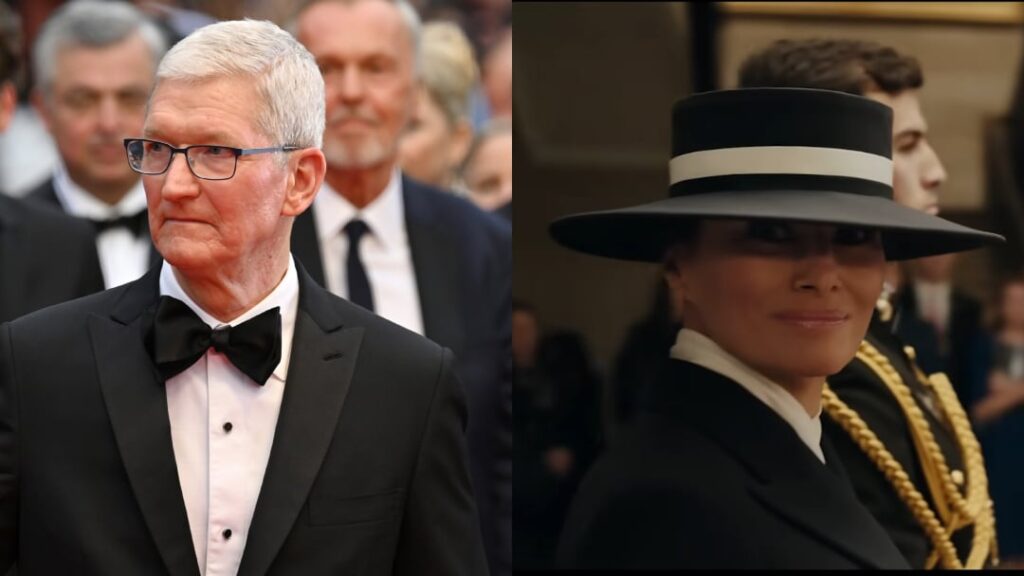
All the while their corruption is visible for all to see. Once-admired executives now court authoritarian leaders, fund propaganda-like projects, and normalize collaboration with agencies that trample our civil liberties. The latest example is Tim Cook prostrating himself to fawn over a third-rate movie that’s really just a $75 million bribe from Amazon to Trump.
Cook sucking up to Trump made it clear that there are no limits of decency, even to one who was formerly decent.
Tech still depends on public trust, public infrastructure, public education, and a stable democracy. But instead of defending those foundations, too many companies are hollowing them out—confident they can outlast the damage. And as they become bigger, they care even less. The original promise of technology was our empowerment. What we are getting instead is domination, surveillance, and consolidation—wrapped in AI hype.
The best resistance to all of this is for us to just say no and fight back the only way these companies understand. Stop doing business with them. Stop upgrading your phones, delay replacing your old computers, cancel your Amazon Prime membership. Just don’t patronize those that support those taking away our rights.
Here is a LIST to get started.

Interesting (and new to me) link. I stopped using most of those companies long ago for reasons that were compelling even before they tipped full fascist (note: the omission of Google from that list is concerning). Now I need to confront my final two: Microsoft and Verizon. My continued patronage of both of these is the result mostly of laziness on my part rooted in my corporate career; corporate IT people chose Microsoft so it was the path of least resistance for me, and I still use the same phone company I did when I joined GTE Mobilnet in 1989 (in fact I left GTE in 1998 precisely because it was about to be absorbed into the Verizon borg but I kept the service). It’s difficult (but not impossible) to avoid Microsoft as a PC user, but I’m not sure it’s possible to use a cellphone without engaging the physical network of one of Verizon, AT&T or T-Mobile (which ties back to Deutsche Telekom that is no more virtuous than the other two). On the other hand, cellphones (read: location tracking) are what enable ALL of their worst tendencies so maybe it’s time to reconsider THAT relationship in its entirety.
One alternative is using an MVNO like Mint or Tello. While they use the networks of the main carriers, they are an improvement. I wrote to the CEO of Verizon, noting I have been a subscriber for 17 years, and asked about their involvement. I never received a reply. Likely I will be moving all 7 lines to T-Mobile.
No real disagreement here. Cellphone networks are kind of like the electric grid; only one operator (if that) is willing to invest in the physical plant but plenty of operators are willing to use that infrastructure once it’s in place. There were literally dozens of physical cellular network operators when I started out, but 4G (and now 5G) saw that consolidate down to the Big 3. It is – or should be – government that wants competition; profit-making companies hate to compete and would much rather collude or consolidate. EVERY MVNO operating in the US rides on one of the Big 3 networks, so if your goal is to keep from funding Verizon or AT&T then T-Mo (and the MVNOs it serves) is your only choice. I would argue that’s a Sophie’s Choice since T-Mo is controlled by D-T (which is larger than both Verizon and AT&T and easily out-shames them globally), but the idea of not having a cellphone at all is inconceivable to most people.