
I moved my family plan from Verizon to T-Mobile and Verizon has made it particularly difficult, well beyond what’s needed to prevent fraud.
I hesitated for years. We have seven phones and two watches spread across two cities five hundred miles apart — exactly the kind of family account carriers love. The bigger and more geographically scattered the plan, the less likely you are to leave. Inertia is their most powerful retention tool.
Several things finally pushed me to act. Verizon’s substantial communications contracts with ICE — second only to AT&T — made me uncomfortable. I’ve been supportive of the boycott efforts encouraged by Neil Young and Scott Galloway, urging consumers to rethink where they spend their money.
There were practical reasons too. T-Mobile includes international data at no extra charge and offers free in-flight Wi-Fi on airlines like Alaska, Delta, and Southwest. Their network performance is now pretty much on par with Verizon and AT&T, and several phones on my account were aging and needed replacement. The best free phone deals, of course, are reserved for new customers — not loyal ones.
Before pulling the trigger, I wrote to Verizon’s CEO, Dan Schulman (dan.schulman@verizon.com), explaining that after 17 years as a Verizon customer, I’d like more information about the company’s ICE involvement. I explained I was considering leaving because of that, but he never responded. That made the decision easier.
The Friction Begins
A T-Mobile customer service agent walked me through their latest promotions and sent a written proposal. Five new phones, $800 credit per line and $25/month lower than Verizon. All I needed from Verizon was a “port-out PIN” to transfer our numbers.
Simple — in theory.
When I logged onto both Verizon’s website and app to try to generate the PIN, I received the same error message repeatedly: “Error occurred with authentication,” with a special number to call. Clearly the website link was either broken or purposely disabled.
I called and an agent answered on the first ring and asked why I was leaving. I requested the PIN first. He then countered with a retention pitch: four free phones and a $70 monthly loyalty credit. Sounded too good to be true, so I asked him to send the offer in writing and we scheduled a call the following day. He never sent the proposal. He never called back. That made the decision even easier.
The Transfer
Moving content between phones was surprisingly painless. Place the old and new iPhones side-by-side, wait about ten minutes, and everything transfers — apps, settings, photos. An Android phone is nearly as easy – it just requires an Apple app from the Play Store. You skip the step that moves the cellular plan. The old phone keeps working; the new phone activates with a temporary number.
The final step is moving your phone number from your old phone to the new. You contact T-Mobile and provide your Verizon account number and the port PIN. Two minutes later, your old Verizon number in activated on your new T-Mobile phone.
Until it isn’t.
When transferring the fourth line a few days later, I tried logging back into Verizon to retrieve my account number. Even though I was still the primary account administrator and responsible for payments, I was locked out. Since my primary number had already been ported – my mistake – Verizon could no longer verify me through text, and they refused to verify me any other way. They demanded I provide another active number to send a text to and that I answer a security question I had set up 17 years earlier.
Eventually, after bouncing authentication texts between two cities, I got in.
Then another surprise: the account number had disappeared from where it had previously been displayed – apparently because I no longer had an active line.
So I initiated a chat session on the website and asked the agent for my account number. He said he would need to verify me again by sending another text! But I just went through a verification system to reach him on the site, I explained. After some back and forth he agreed to verify me using my email ,and I finally got the account number.
Later in the week when my son tried porting over his family’s three numbers, the port pin did not work. He tried calling Verizon, and even though he is set up as a second administrator, they told him he is not authorized to get a pin.
I then went back on the site to the page where the pin is generated, and it said I could not generate a new pin because there was an active pin already issued. It said I could cancel the active pin and issue a new one, but hitting the cancel button returned an error and a request to call that same phone number.
Instead I called Verizon’s main number and asked to speak with an agent. When I explained why I was calling and asked for a new pin, the line disconnected. I called a second time and reached another agent, and after making the same request, the line went dead again. I tried a third time and reached an agent who promised he would not hang up and after 5 minutes on hold – while expecting to be disconnected – he provided me with a new pin. That pin worked and all of our phones are finally on T-Mobile. Phew.
The Results
We now have new phones and full service at a slightly lower monthly cost. International roaming issues and Verizon’s day passes are now a thing of the past. Airline Wi-Fi is included and our old phones have been replaced with new ones.
What disappointed me wasn’t that Verizon tried to retain me — that’s to be expected. It was the lack of follow-through combined with all the friction that they intentionally introduced.
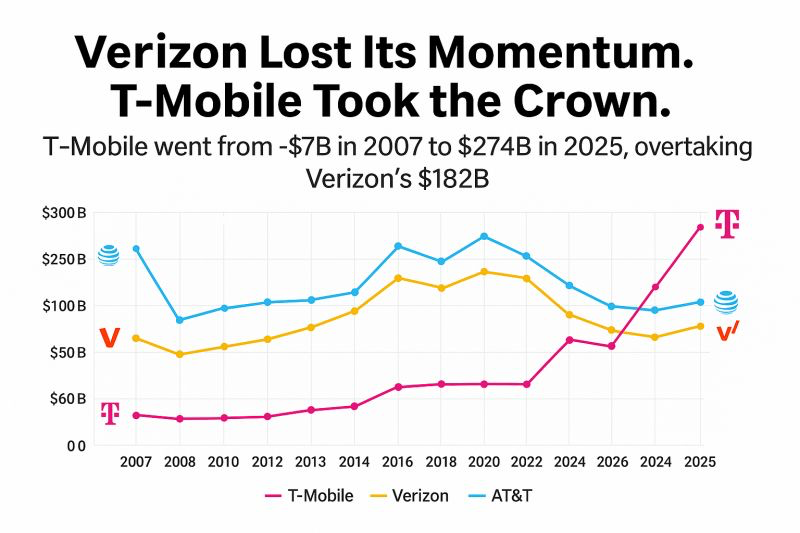
And apparently I’m not alone in switching from Verizon to T-Mobile. This past year T-Mobile has added roughly 3.3 million phone subscribers, while Verizon has lost subscribers, mostly to T-Mobile.
When you make it difficult for customers to leave and they eventually do — you’re insuring they will never come back. I will remember the difficulty Verizon gave me at the end, not the good service they provided for many years.

Wow, this is very interesting as a long-time Verizon customer! I’ll have to check it out.